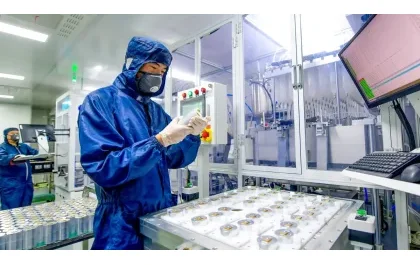

A Chinese researcher has developed a new sodium-ion battery capable of charging in just four minutes, marking a significant breakthrough that could reduce China's heavy reliance on lithium, the key material used in most modern rechargeable batteries.
The innovation was led by Lu Yaxiang, a researcher at the Chinese Academy of Sciences, who has spent more than a decade working to commercialize sodium-ion battery technology. His research aims to provide a more affordable and sustainable alternative to lithium-ion batteries, which currently dominate the global energy storage market.
In recognition of his achievements, Lu was awarded the prestigious China Youth May Fourth Medal in April 2026. The national award honors outstanding young innovators and leaders who have made exceptional contributions to the country's scientific and technological development.
According to the research, the newly developed sodium-ion battery can be fully charged in approximately four minutes while maintaining impressive durability. It retains around 90% of its original capacity after more than 2,000 charging cycles, making it a promising option for long-term use in a wide range of applications.
The breakthrough is particularly important for China because the country imports nearly 75% of the lithium it consumes. Unlike lithium, sodium is one of the most abundant elements on Earth and can even be extracted from seawater. It is also significantly cheaper, making sodium-ion technology a potentially more cost-effective solution for future battery production.
China's progress in sodium-ion technology extends beyond Lu Yaxiang's research. Chinese battery manufacturer Gotion has also announced the development of a high-performance sodium-ion battery capable of maintaining its quality after up to 20,000 charge cycles. Such advancements indicate that sodium-ion batteries are rapidly closing the performance gap with conventional lithium-ion batteries.
The technology has already begun moving from research laboratories to commercial deployment. China is operating one of the world's largest sodium-ion battery energy storage stations, with the capacity to supply electricity to approximately 12,000 households. This demonstrates the growing role of sodium batteries in supporting renewable energy and strengthening power grids.
Although sodium-ion batteries still have lower energy density than lithium-ion batteries—typically around 150–175 Wh/kg, compared to 250–280 Wh/kg for some advanced lithium-ion batteries—experts believe the technology is improving at a rapid pace. Continued research and manufacturing advancements are expected to further narrow the performance gap.
Industry analysts predict that sodium-ion batteries could achieve cost competitiveness with lithium-ion batteries by 2027, allowing them to compete more effectively in global markets.
The new battery technology has the potential to transform several industries. It could be used in electric vehicles (EVs) that require fast and affordable charging, large-scale energy storage systems supporting renewable sources such as solar and wind power, as well as consumer electronics and industrial equipment that demand long-lasting battery performance.
With sodium being far more abundant and less expensive than lithium, this emerging technology could significantly reduce battery manufacturing costs while helping countries diversify supply chains and reduce dependence on scarce critical minerals. As research continues, sodium-ion batteries are increasingly being viewed as a viable complement—and in some applications, a potential alternative—to traditional lithium-ion technology.

Mugisha Alexis
1 month agoIs good product with heavy impact for sure